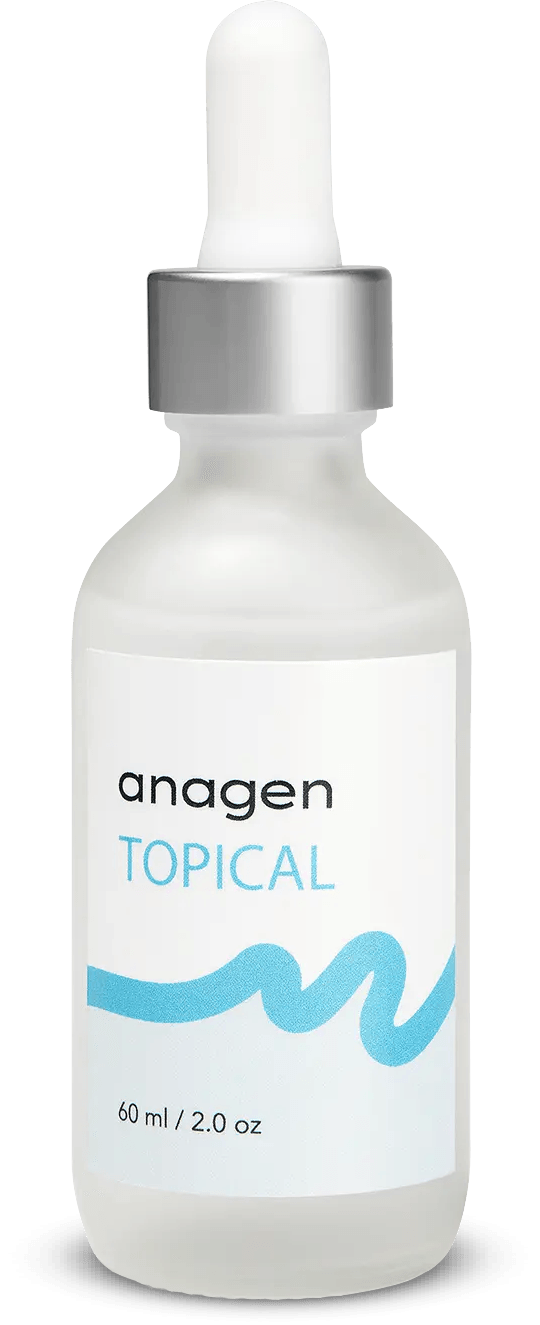
Precision
Dutasteride

Designed to strongly inhibit scalp 5α-reductase while minimizing systemic absorption.

  • 1Dutasteride inhibits both type I and type II isoenzymes for powerful suppression of scalp DHT.
  • 2Anagen's proprietary delivery vehicle causes liposomes to preferentially aggregate in a follicular reservoir for localized diffusion to dermal papilla cells.
  • 3At our new 1% dose, an early two-person blood check found serum dutasteride below the assay's limit of quantification.
A dropper deposits Precision Dutasteride lipid vesicles that route into the follicle, partition into the sebum reservoir, and release dutasteride that diffuses to the dermal papilla. Schematic, not to scale.
Key termStratum corneum. The skin's brick-and-mortar outer barrier, the rate-limiting step for anything applied to flat skin.
Key termFollicular reservoir. The follicle canal acts as a shunt past that barrier and a slow-release depot for the drug.
Key termConcentration gradient. By Fick's law, drug diffuses from high to low concentration; a steep local gradient drives it into the dermal papilla.
02 The Strategy

Why we deliver through the follicle.

Dutasteride is one of the most potent DHT blockers there is, but its target sits deep inside the follicle, and taken orally it suppresses DHT across the whole body. The entire job of a topical is to put that potency at the follicle and minimize systemic absorption. That's a delivery problem, and it's the one Precision Dutasteride's vehicle is built to solve.

Key term · Stratum corneumThe skin's brick-and-mortar outer barrier, the rate-limiting step for anything applied to flat skin. The follicle canal is the shunt past it.
  1. 1The target is deep and local. Inside the follicle, 5α-reductase converts testosterone into DHT, and DHT acts on the dermal papilla at the base of the follicle to miniaturize it. The drug has to reach the dermal papilla, locally, deep in the follicle.
  2. 2Flat skin blocks the way. The stratum corneum, the skin's outer "brick-and-mortar" layer (keratin cells packed in a lipid matrix), is the rate-limiting barrier to topical drugs; intact lipid vehicles essentially can't cross it.
  3. 3The follicle is the shortcut. The follicle opening bypasses that barrier: the drug and its lipid vesicles funnel down the follicular canal and pool in the sebum as a long-lived "follicular reservoir": reaching depth, and lingering, in a way flat-skin diffusion can't.
  4. 4A localized gradient does the targeting. Concentrating the drug in the follicle builds a steep local concentration gradient. By Fick's law, diffusion flows from high to low concentration: a strong push across the thin canal wall into the dermal papilla, exactly where it's needed. Because the depot is small and local, the outward gradient is weak, so little drug spreads to the deeper dermis or the bloodstream.
High exposure at the follicle, low exposure everywhere else.

That is the whole rationale for follicular targeting: the local action of dutasteride with far less of the systemic trade-off. Which is why we screened dozens of vehicles for exactly this property, and the rest of this page is the evidence the vehicle actually does it.


Figure refPlate 02. Each bar is one delivery system tested ex vivo, grouped by family and ranked. Bar length is its follicular targeting factor: how strongly it routes drug into the follicle versus the surrounding skin, at 12 h and 24 h.
Reading the plotThe dashed line marks the mineral-oil control (0.31). Anything to its right beats the simplest possible vehicle.
NoteThe winning vehicle powers Precision Dutasteride; its proprietary identity and composition remain confidential.
03 The Vehicle Screen

More than 60 delivery systems went in. One came out ahead.

A vehicle is only as good as where it puts the drug. We screened the field (liposomes, ethosomes, transfersomes, polymer nanospheres and nanocapsules, mineral carriers) for one property: routing dutasteride into the follicle.

Figure ref · Plate 02Each bar is one delivery system tested ex vivo (teal = 12 h, coral = 24 h), grouped by family and ranked. The dashed line is the mineral-oil control (0.31); anything past it beats the simplest vehicle. The winning vehicle powers Precision Dutasteride; its proprietary identity and composition remain confidential.
Plate 02Ranked field · follicular targeting factor
0.000.100.200.300.400.500.600.70Follicular targeting factor — drug routed into the follicle vs surrounding skin (higher is better)PrecisionDutasteridethe winning vehicleWINNER0.64 · 12 h0.58 · 24 hPLGA nanospheresbest 0.47NSPLGA3233 nm0.470.45NSPLGA2103 nm0.340.38NSPLGA5184 nm0.330.27NSPLGA4169 nm0.180.18NSPLGA1117 nm0.110.34Multi-lamellar liposomesbest 0.440.16 mg/mL0.440.240.40 mg/mL0.260.40Controlsbest 0.44Free DUTserum0.130.44DUT suspensioncontrol0.200.35Mineral-oil controlreference0.310.24Mineral / CaHa microparticlesbest 0.39CaHa 5%0.390.15CaHa 2.5%0.130.23PCL nanospheresbest 0.37NS11628 nm0.370.14NS1173 nm0.300.33NS15891 nm0.200.16NS7317 nm0.150.09Nanoemulsions24 h only · best 0.35NE-10.35NE-20.34NE-30.31NE-40.30NE-50.29NE-60.27NE-70.26NE-80.20Ethosomesbest 0.34ET300.280.34ET30-EFrotaevap.0.270.28Liposomesbest 0.33Transfersome0.330.28LP PC + Chol0.150.27LP PC0.140.13PCL nanocapsulesbest 0.33PCL20459 nm0.330.19PCL16289 nm0.190.13PCL1187 nm0.170.05Vendor samples24 h only · best 0.25Sample B0.25Sample D0.23Sample A0.15Sample C0.14Mineral-oil control 0.31
Plate 02. Ex-vivo follicular targeting factor (mean ± SD), porcine / rat skin, 12 h and 24 h. This is a delivery measure (how well a vehicle routes drug into the follicle), not a measure of clinical hair growth. Over 60 systems screened; the winning vehicle behind Precision Dutasteride reaches 0.64 at 12 h versus ≈ 0.47 for the best alternative.

Figure refPlate 03. Each pair of bars is one patient's serum DHT before starting Precision Dutasteride and at follow-up. The shaded band is a typical adult-male reference range.
Read honestly A follicle-local topical should leave systemic DHT largely unmoved. Stable serum DHT is the expected, reassuring result, not an efficacy claim.
04 Serum DHT

Early Precision Dutasteride patients show no decrease in serum DHT.

If the drug truly stays local, systemic DHT should barely move. Across six early patients we monitored serum DHT (ng/dL) at baseline and follow-up. This is real-world observational monitoring (n = 6), not a randomized or controlled endpoint.

Plate 03Serum DHT · baseline → follow-up (n = 6)
020406080100Serum DHT (ng/dL)65124039868028274246673350P1P2P3P4P5P6
Mean change +10.6% (n = 6)

Minimal systemic DHT change, consistent with a follicle-local topical that leaves circulating hormone largely unmoved.

Plate 03. Real-world observational serum-DHT monitoring in early Precision Dutasteride Lite (0.03%) patients (n = 6), baseline → follow-up, June 2026. Observational patient monitoring; not a randomized or controlled endpoint. Precision Dutasteride (0.3%) serum-DHT monitoring is ongoing, not yet reported.

Figure refPlate 04. Two compartments after dosing ex vivo: drug recovered in the follicle, and drug reaching the deeper viable skin (the receptor compartment a stand in for what could enter circulation).
Key termBelow detection (ø). Too little drug to quantify with the assay; the receptor compartment did not register a measurable amount.
05 Stays Local

In skin tests, the drug concentrates in the follicle with variability between wet and dry scalp.

Targeting only matters if the drug also stays put. Ex vivo, dutasteride accumulated in the follicle while the deeper viable-skin compartment (the path toward circulation) stayed below the assay's detection limit. More dutasteride was recovered from the follicle in wet scalp conditions compared to dry.

Figure ref · Plate 04Drug recovered in the follicle versus drug reaching the deeper viable skin (the receptor compartment, a stand in for circulation). “Below detection (ø)” means too little to quantify.
Plate 04Compartment recovery · follicle vs systemic
Recovered in the follicleµg/cm² · higher = more drug held locally02.557.510~5Dry scalp~9Wet scalp≈1.8×Reaching deeper skin (systemic route)receptor compartment · the path to circulation0510øDry scalpøWet scalpBelow detectionno quantifiable drug in either condition
Plate 04. Ex vivo compartment recovery. Drug held in the follicle reached ≈ 5 µg/cm² (dry scalp) and ≈ 9 µg/cm² (wet scalp, ≈ 1.8× dry), with sustained release over time; the deeper viable skin (receptor) compartment was below the assay's detection limit in both conditions. An ex vivo measure of where the drug goes, not a clinical PK study.

Key termLLOQ. The lower limit of quantification: the smallest concentration the validated assay can measure reliably. Here it is 0.1 ng/mL. Signal below it is detectable, but the exact number can't be trusted.
The dose1%. The highest strength we've made: about 33× the 0.03% Lite and roughly 3× the 0.3%. If any strength were going to show up in blood, it's this one.
Read honestly Two people is a pilot, not a trial, and every reading sat below the assay's floor. This shows no measurable systemic rise, not proof of zero absorption.
06 The 1% Test

We pushed the dose to 1%. Serum dutasteride stayed below what the assay can measure.

Two of us applied 1 mL of the 1% formulation to the scalp once daily for four days, with serum dutasteride measured by LC-MS/MS before the first dose and after the fourth. The assay's limit of quantification was 0.1 ng/mL, run with a standard curve and QCs.

Figure ref · Plate 05Baseline vs day-4 bars for two participants, one who applied to a damp scalp, one dry. The axis tops out at the assay's limit of quantification (0.1 ng/mL), so every bar sits in the shaded below-quantification zone. A 0.5 mg oral dutasteride pill would be ≈ 40 ng/mL, about 400× off the top.
Plate 05Serum dutasteride · 1% dose · baseline → day 4 (n = 2)
0.000.020.040.060.080.10Serum dutasteride (ng/mL)Limit of quantification · LLOQ 0.1 ng/mLBelow limit of quantificationdetectable, but not reliably measurable▲ Oral 0.5 mg/day pill ≈ 40 ng/mL≈ 400× above this axis · → ≈ 90% serum DHT suppression0.0110.053Participant 1damp scalp · 1% · 1 mL/day0.0240.011Participant 2dry scalp · 1% · 1 mL/day
Every reading below the limit of quantification < 0.1 ng/mL

All four samples came back below the assay's floor, hundreds of times under the ≈ 40 ng/mL an oral dutasteride pill puts in your blood. The damp-scalp reading ticked up and the dry one didn't, echoing the wet-beats-dry uptake we saw ex vivo (Plate 04). But both stayed below quantification, so that gap is noise. Suggestive, not proof.

But is that low enough to leave DHT alone?

To move DHT, dutasteride has to be in your blood. The 0.5 mg pill that drops serum DHT about 90% runs near 40 ng/mL, roughly 400 times our assay's floor and far above anything we measured. Even a 0.01 mg dose, the lowest in the dose-ranging studies, leaves serum dutasteride below detection. So under 0.1 ng/mL is well beneath what it takes to move circulating DHT, which is why serum DHT didn't budge in our early monitoring (Plate 03). We don't give a hard cutoff because there isn't one: dutasteride binds 5α-reductase for good, so the effect follows enzyme turnover, not a single blood level.

Plate 05. Two-person internal systemic-exposure pilot (n = 2), Precision Dutasteride 1%, 1 mL once daily × 4 days. Serum dutasteride by LC-MS/MS (calibration range 0.1–100 ng/mL; LLOQ 0.1 ng/mL; standard curve + QCs). All samples detectable but below the limit of quantification; baseline was also below LLOQ. Oral steady-state reference ≈ 40 ng/mL for dutasteride 0.5 mg/day (Avodart SmPC). A pilot systemic-exposure check, not a controlled pharmacokinetic study.

Four days is not steady state. So both participants kept applying for another four weeks — Participant 1 holding at 1 mL a day on a damp scalp, Participant 2 doubling to 2 mL a day on a dry one. At day 30 we drew serum again on a fresh batch. This time both samples cleared the LLOQ of 0.1 ng/mL.

Figure ref · Plate 06The same two participants, the same assay, four weeks later. The axis that Plate 05 capped at the assay's floor now runs past it, so the floor becomes a line the day-30 bars cross. The July readings are drawn as a hatched band rather than a bar: they sit somewhere below 0.1 ng/mL and the run cannot say where.
Plate 06Serum dutasteride · 1% dose · day 4 → day 30 (n = 2)
0.000.050.100.150.200.250.300.35Serum dutasteride (ng/mL)▲ Oral 0.5 mg/day pill ≈ 38 ng/mL110× above the top of this axisLLOQ 0.1 ng/mL< 0.10.1570.41% of oralDay 41 mL/dayDay 301 mL/dayParticipant 1damp scalp< 0.10.2820.74% of oralDay 41 mL/dayDay 302 mL/dayParticipant 2dry scalp
Thirty days on the strongest formula we make 0.157 & 0.282 ng/mL

Participant 1, at 1 mL a day, measured 0.157 ng/mL. Participant 2, who had doubled to 2 mL a day, measured 0.282 ng/mL. A 0.5 mg oral dutasteride capsule sits near 38 ng/mL at steady state, so the heavier of the two topical doses landed at roughly three quarters of one percent of the oral serum concentration.

Two men at two different doses gives us more than two numbers. It gives us a rate, and a rate works on every strength we make.

What reaches the blood

Every milligram you apply puts about 0.015 ng/mL into your blood.

Serum dutasteride by formula and daily volume
FormulaDaily volumeDrug appliedIn your bloodSource
0.03%1 mL/day0.3 mg0.005 ng/mLmodeled
0.3%1 mL/day3 mg0.045 ng/mLmodeled
1%Participant 11 mL/day10 mg0.157 ng/mLmeasured
1%Participant 22 mL/day20 mg0.282 ng/mLmeasured
XYON 2% gelcompetitor, n = 9not statednot reported1.34 ng/mLmeasured
Oral capsulefor scaleone capsule0.5 mg38 ng/mLpublished

Only the two 1% rows were measured in our own participants. The 0.03% and 0.3% rows are this constant projecting from those two men, and have never been observed directly. The XYON row is their own published figure from a patent filing, where the amount applied was described only as a thin layer and never reported. The oral row is published data, shown so the scale is visible.

Wet scalp did not change what reached the blood

Participant 1 applied to a damp scalp and took up 0.0157 ng/mL per milligram. Participant 2 used a dry scalp and took up 0.0141. Those are close, within 11%. That is one person per condition, and their doses differed too, so read it as a hint and not a finding.

Where this constant is thin

It rests on two people. Published dutasteride pharmacokinetics vary roughly 70% between individuals, so one person can sit well outside these numbers. A July sample on 0.3% at 2 mL came back under the assay floor, which this constant predicts at 0.089 ng/mL. That agreement rules out constants above 0.0167 and nothing tighter.

So what does that do to DHT? We did not measure it in either participant, so the honest answer is a range rather than a number. Here is what the published curve predicts, and how that compares to the way serum DHT drifts on its own.

Predicted, not measured

How far these doses are expected to move serum DHT.

Best estimatePredicted DHT decrease range

Every topical dose is predicted to move DHT less than it drifts on its own. Serum DHT is not a steady number. Draw blood from the same man twice with no treatment at all and the two results differ, half the time by more than 18% to 28%. All four topical predictions sit under that. The oral capsule does not, and that gap is what the product is built around.

The one published result that does not fit

XYON reports 1.2 to 1.5 ng/mL of dutasteride in the blood on their 2% gel, and no measurable change in DHT, in 9 men. Those two numbers are hard to hold together. In the trial GSK filed with the Japanese regulator, men at 1.51 ng/mL saw serum DHT fall 64.9%, in 65 men, p below 0.001. The curve behind every other number on this chart predicts 59% at XYON's serum dutasteride concentration. Gold standard randomized trial data, and our own model built on that data, both predict vastly more DHT suppression than XYON reported.

GSK CTD Module 2.7, submitted to Japan's PMDA for dutasteride in male pattern hair loss, Table 2.7.2.2-2 (serum dutasteride) and Table 2.7.2.2-6 (serum DHT), study ARIA2004, week 24. XYON figures from US patent application 2023/0181430 A1, Tables 9 and 11.

DHT was not measured in either participant. These are projections from a curve fitted to Clark 2004, resampled to carry its uncertainty, and our exposures sit below the lowest concentration Clark measured directly. Read the ranges, not the midpoints. Scalp DHT, the endpoint that decides whether a follicle-targeted vehicle works, has never been measured in a human on this formula. That is what the trial is for.

Plate 06. Same two participants as Plate 05, continued to 30 days on Precision Dutasteride 1%; serum drawn 24 Aug 2026 and assayed by LC-MS/MS in a single batch (calibration 0.1–500 ng/mL, 1/x² weighting, r = 0.9993; controls 95.2–100.4% of nominal at 1.5, 150 and 375 ng/mL; automatic integration throughout). Participant 2 changed dose between the two timepoints, so his pair is not a time course. Oral reference ≈ 38 ng/mL for dutasteride 0.5 mg/day (Clark 2004). Both samples fall below the batch's lowest control (1.5 ng/mL) — inside the calibrated range, outside the bracketed control range. n = 2, one sample each, no placebo and no randomisation: a pilot exposure check, not a pharmacokinetic study.

Clinical context

Dutasteride's hair-growth efficacy as a dual 5α-reductase inhibitor is well established and covered in depth elsewhere. This page is about delivery: getting that established molecule into the follicle while minimizing systemic absorption.

See the dutasteride hair-science page →
07 The Bottom Line
01 · Delivery

Targeted vehicle

The winning vehicle routes drug into the follicle: 0.64 vs ≈ 0.47 for the best alternative.

Measured · ex vivo
02 · Hormone

Serum DHT unmoved

Across 6 early patients, serum DHT showed no decrease (+10.6%); stays within range.

Observed · n = 6
03 · Local

Stays in the follicle

Drug accumulates in the follicle; the deeper systemic route stayed below detection.

Measured · ex vivo
04 · Systemic

Below quantification at 1%

At our highest dose, serum dutasteride stayed below the assay's limit of quantification, before and after.

Observed · n = 2
05 · Dose

Dial the strength

0.03% and 0.3%, plus a new 1%. A clinician dials the local dose to the plan.

Product
Choose your dose

Three strengths, one follicle-targeting vehicle.

Choose from 0.03%, 0.3%, and 1%. A licensed clinician decides which strength is right for you.

Precision Dutasteride Lite pairs our lowest 0.03% dutasteride concentration with the follicle-targeting delivery system used across the Precision Dutasteride line.

  • Dutasteride

Starting at$80/month

Explore

Precision Dutasteride pairs a 0.3% dutasteride concentration with our follicle-targeting delivery platform.

  • Dutasteride

Starting at$80/month

Explore

Precision Dutasteride Max pairs our highest 1% dutasteride concentration with the follicle-targeting delivery platform used across the Precision Dutasteride line.

  • Dutasteride

Starting at$80/month

Explore

What this page can and can't support

  • Vehicle data is ex-vivo follicular targeting: a delivery measure (where the drug goes), not clinical hair growth, and not serum-DHT suppression on its own.
  • The serum-DHT set is observational (n = 6), not a controlled PK or hormone study; stable DHT is the expected result for a topical, not proof of efficacy.
  • The 1% systemic check is a two-person pilot: every reading sat below the assay's limit of quantification (0.1 ng/mL). It shows no measurable systemic rise at a high dose, not a guarantee of zero absorption, and a larger sample is needed to confirm it.
  • 0.3% serum-DHT monitoring is pending: we report only what we've measured, and Precision Dutasteride (0.3%) hormone data is not yet available.
  • Prescription product, clinician-gated. Suitability is decided by a licensed clinician. This page is treatment science, not medical advice.
Sources
  1. Anagen internal systemic-exposure pilot: serum dutasteride by LC-MS/MS, Precision Dutasteride 1% (1 mL once daily × 4 days), n = 2, July 2026; all samples below the assay's limit of quantification (0.1 ng/mL). A pilot check, not a controlled PK study.
  2. Anagen internal patient observation: serum DHT, n = 6, June 2026 (real-world monitoring; not a controlled study).
  3. HairDAO / Universidade de Brasília vehicle-screening: follicular targeting factor, ex-vivo (porcine / rat skin). A delivery measure, not a clinical-efficacy endpoint.
  4. Clark RV, Hermann DJ, Cunningham GR, Wilson TH, Morrill BB, Hobbs S. Marked suppression of dihydrotestosterone in men with benign prostatic hyperplasia by dutasteride, a dual 5α-reductase inhibitor. J Clin Endocrinol Metab 2004;89(5):2179–2184 (PMID 15126539). Oral steady-state serum reference for the topical comparison.
  5. Dutasteride oral pharmacokinetics and pharmacodynamics: steady-state serum ≈ 40 ng/mL on 0.5 mg/day, with serum DHT reduced ≈ 90%: Avodart 0.5 mg Summary of Product Characteristics.
  6. Low-dose serum dutasteride reaches the assay floor: a single 0.01 mg oral dose produced serum concentrations below the limit of detection. Gisleskog PO et al., Br J Clin Pharmacol 1999;47:53–58 (PMID 10073740).
  7. Dutasteride clinical pharmacology: see the dutasteride hair-science page.
© 2026 Anagen · Treatment Science · Precision Dutasteride. Prescription product; clinician-gated. Not medical advice.Choose your dose →